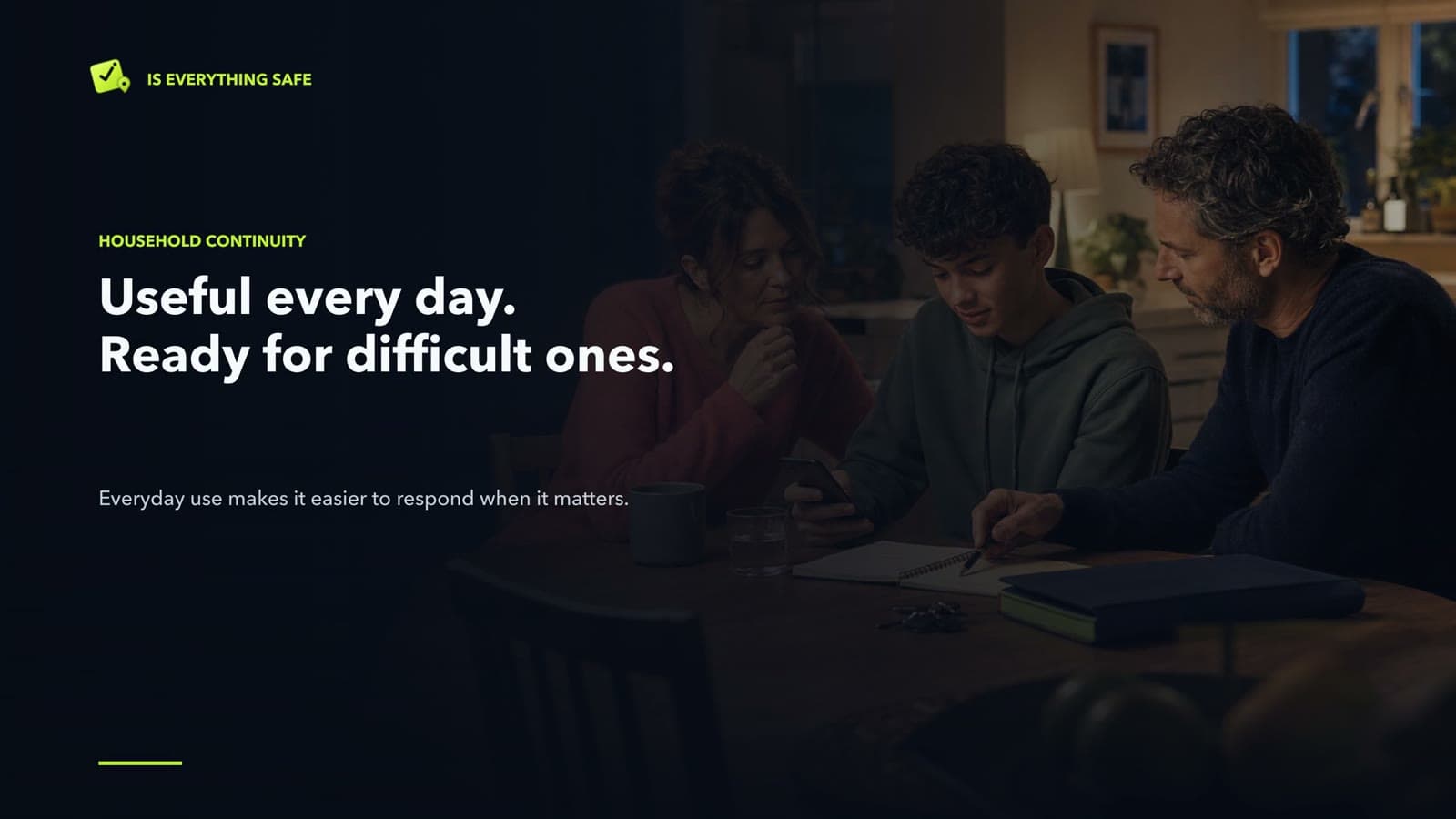
Everyday Preparedness for Households: Why Being Organised Matters More Than Ever
Preparedness is not just about national systems. It is about whether your household can stay organised, connected, and ready to act when disruption happens.

Preparedness is often discussed as a national issue.
We hear about cyber attacks, infrastructure risks, severe weather, supply chain disruption, energy resilience, public safety, and disinformation. But while those risks may start at system level, they are usually experienced at household level.
That is why everyday preparedness matters.
For most people, disruption is not first experienced as a policy issue. It is experienced as confusion, delay, and stress. Important documents are hard to find. Key contacts are missing. Deadlines are overlooked. Trusted updates are spread across too many places. One person in the household knows what is going on, but nobody else does.
This is the real preparedness gap.
What is everyday preparedness?
Everyday preparedness means building simple habits and systems that help your household respond when life does not go to plan.
It is not about panic.
It is not about extreme scenarios.
It is about practical readiness.
For a household, that usually means being able to:
- access important documents quickly
- keep insurance, ID, and key records organised
- store emergency and professional contacts in one place
- stay on top of renewals, deadlines, and responsibilities
- follow trusted alerts and official information
- share access and visibility across the household
These are small actions, but they make a major difference when disruption happens.
Why household preparedness is becoming more important
Modern risks are interconnected.
A cyber issue can affect transport.
A transport issue can affect work and school.
A utility disruption can affect communication, health, and household routines.
A severe weather event can quickly become an insurance, documentation, and coordination problem.
In other words, national risks often become household problems very quickly.
That is why preparedness needs to be practical, relevant, and achievable in everyday life.
The challenge is not awareness. It is action.
Most people already know disruption is possible. The issue is not a lack of awareness. The issue is that preparedness often feels too broad, too complicated, or too easy to delay.
If preparedness depends on memory, scattered paperwork, and one person holding all the key information, it is fragile by default.
The better approach is to reduce friction.
Preparedness works best when it becomes part of ordinary household organisation.
How Is Everything Safe supports everyday preparedness
At Is Everything Safe, we think about preparedness as household continuity.
Our focus is helping households stay organised, connected, and able to act when life becomes more complicated.
That includes tools to help you:
- store important documents in a secure encrypted vault
- keep household records and item information together
- manage reminders and key dates
- maintain emergency and professional contacts
- share visibility across the household
- follow trusted alert sources in one place
We are not a replacement for emergency services or official advice. We are focused on the practical household layer that helps people respond faster and with less confusion.
Preparedness starts before the disruption
The best time to organise key documents is before you urgently need them.
The best time to confirm important contacts is before communication becomes difficult.
The best time to share responsibilities is before one person is unavailable.
Preparedness is not just about reacting well.
It is about making everyday life more resilient in advance.
Final thought
Preparedness does not need to feel overwhelming.
In many cases, it starts with something simple: getting your household information organised, visible, and usable.
Because when disruption happens, the households that cope best are often the ones that can act quickly, communicate clearly, and find what they need.
That is what everyday preparedness looks like in practice.
Sources
- https://nationalpreparednesscommission.uk/wp-content/uploads/2024/02/NPC_HULL_Building-Everyday-Preparedness_112023HD-3.pdf
- https://nationalpreparednesscommission.uk/wp-content/uploads/2024/03/NPC_Making-It-Happen.pdf
Build your household setup before you need it
Keep important records, contacts, reminders, trusted alerts, and ownership information in one place so your household can act earlier and recover with less chaos.