The New Resilience: Why Safer Lives Will Be Built Long Before a Crisis Begins
Today we are announcing an important new partnership between IsEveryoneSafe and the Neighbourhood Watch Network. Resilience starts much earlier.

Today we are announcing an important new partnership between IsEveryoneSafe and the Neighbourhood Watch Network. A generation ago, safety was often understood in narrow terms. It was about locks, alarms, neighbourhood familiarity, and, in times of crisis, the expectation that institutions would step in and take charge. Today, that definition feels incomplete and this announcement is another step towards closing the gap.
Modern life is more connected, more digital, more mobile, and, in many ways, more fragile. The pressures people feel are no longer confined to dramatic headline events. They live in the everyday: a stolen phone containing everything from banking access to family photos; an expired passport discovered too late; a parent’s important documents scattered across drawers and devices; a missed emergency message; a fraudulent message that looks real enough to trust; a vulnerable neighbour quietly disappearing into loneliness; a community that shares a postcode but not much else. These are not isolated inconveniences. Together, they form the texture of modern insecurity whether young or old.
The challenge for the UK is that resilience is still too often spoken about as though it begins when something has already gone wrong. Resilience starts much earlier. It starts in the quiet systems people build around their lives: how they organise what matters, how quickly they can act under pressure, how easily a household can find trusted information, and whether anyone nearby would notice if help was needed. The Cabinet Office’s 2025 resilience preparedness survey underscored that gap starkly: only a small minority of UK adults felt their household was largely or totally prepared for an emergency or disaster, while over half felt their local community was only slightly prepared or not prepared at all. That should concern all of us, because a country does not become resilient purely through national strategy. It becomes resilient when ordinary people can cope better with disruption, when homes are less chaotic under pressure, and when communities are more connected before they are tested. This is the direction of travel in UK resilience thinking too, with growing emphasis on a whole-of-society model in which individuals, organisations, communities and institutions all play a practical role in building national preparedness.
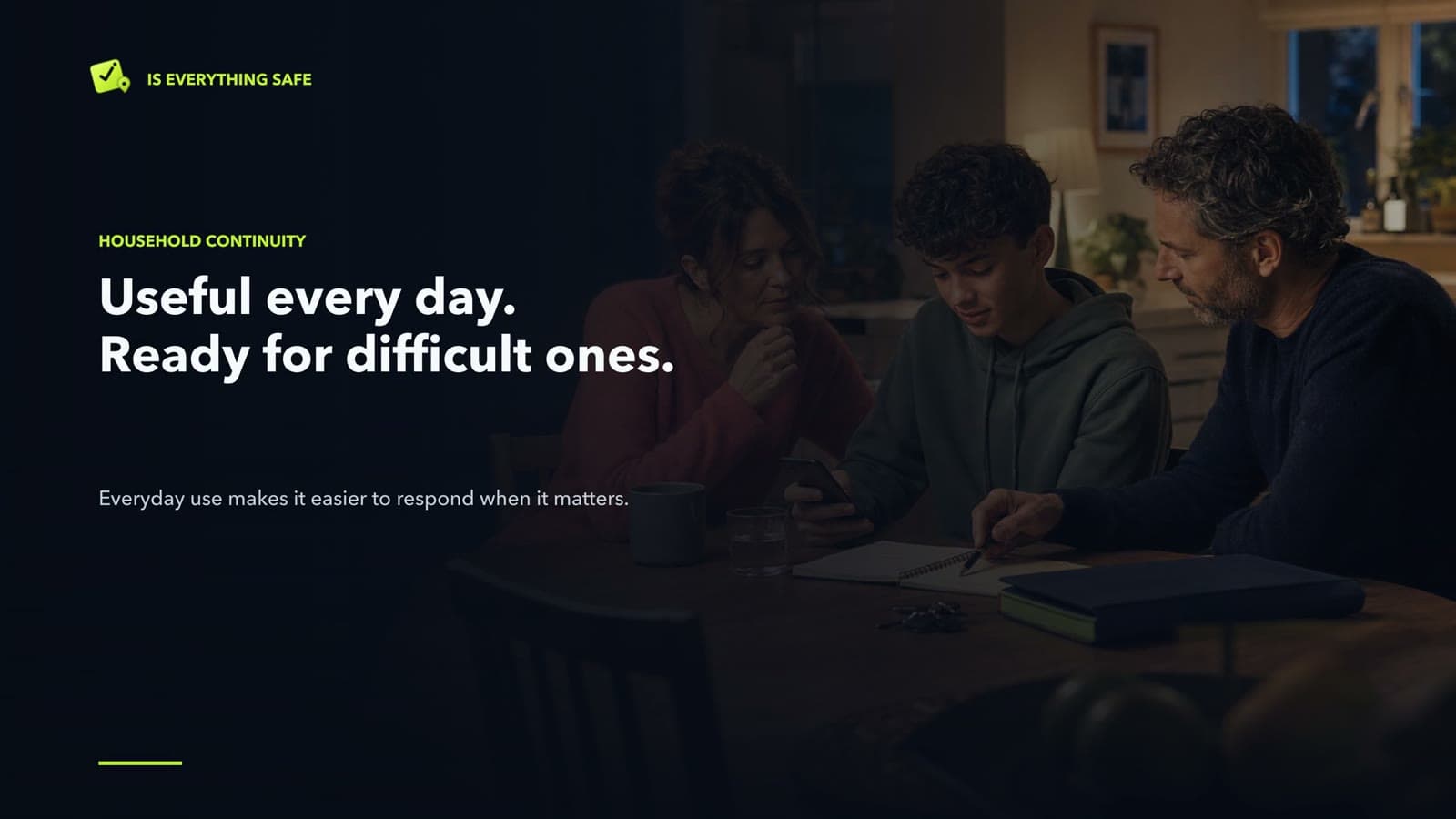
Seen through that lens, one of the most important shifts underway is the move from reactive safety to everyday continuity. This is where a new kind of proposition becomes relevant. Not a platform built around fear. Not another digital tool competing for attention, but something designed around a more human truth: when life becomes difficult, people need clarity, access, trusted signals, and the ability to act. IsEverythingSafe is built in that space. Our proposition is practical and modern: secure household records, shared access, trusted alerts, reminders, continuity workflows, and tools intended to help people stay organised, connected, and ready to act when life does not go to plan. The platform is not only built for convenience, but as something that contributes to societal resilience. An ambitious statement, and an important one.
What makes that idea powerful is that it addresses a truth many brands still miss: resilience is often lost in the handover between intention and action. People may know they should be better prepared, but preparation is difficult when information is fragmented, responsibilities are unclear, and modern life is already overloaded. Secure storage for key records, reminders for critical renewals, shared household visibility, and access to trusted alerts do more than improve convenience. They reduce friction at the point where vulnerability so often begins. Yet resilience is never only a household issue. It is also social.
Society is experiencing a quieter erosion alongside its more visible risks: loneliness, disconnection, and weakening everyday trust. Recent Office of National Statistics data showed that almost a quarter of adults reported feeling lonely often, always, or some of the time, with younger adults especially affected. That matters far beyond wellbeing. Communities with weak ties are less likely to spot vulnerability early, less able to share trusted information, and less able to create the conditions in which people feel safer and more supported. If the Covid pandemic taught us anything, it is that social connection is not a soft extra in a resilient society. It is part of the infrastructure.
That is why the most progressive vision of resilience in the UK is not one that separates personal safety, community strength, and national preparedness into different silos. It is one that understands that they are interdependent. A home that can find what it needs quickly is stronger. A street in which neighbours notice one another is stronger. A community that shares trusted information rather than rumour is stronger. A nation in which institutions, citizens and civic organisations all contribute to preparedness is stronger. This is exactly the spirit reflected in the whole-of-society resilience agenda, championed by the National Preparedness Commission, now gaining momentum across the UK.
In this context, the future of safety looks less like a warning system and more like an ecosystem. It is digital tools that help households stay in control. It is trusted community networks that make people feel less alone and more supported. It is prevention sitting alongside response, and continuity sitting alongside care. It is innovation that strengthens human connection rather than replacing it. And it is brands that understand safety not merely as protection from crime or emergency, but as the ability to navigate life with greater confidence, readiness and collective strength.
This matters because the pressures on individuals are not receding. Fraud remains at very high levels, with the Crime Survey for England and Wales estimating 4.2 million fraud incidents in the year ending September 2025, while the National Cyber Security Centre continues to stress practical cyber guidance for families and smaller organisations alike. The message is clear: vulnerability is now both physical and digital, personal and systemic. A modern resilience response must meet people where they actually live. For individuals, that means less panic and more preparedness. For communities, it means stronger ties and greater awareness. For organisations, it means a new opportunity to contribute to public good in ways that are measurable, useful, and trusted. For brands operating in this space, it means moving beyond compliance language and transactional product messaging toward something more meaningful: helping people feel that life is manageable, that important things are protected, and that they are part of something more connected than themselves.
The UK does not need more abstract language about resilience. It needs resilience made visible in everyday life. It needs households that are better organised before stress hits. It needs communities that are more connected before isolation deepens. It needs institutions and innovators that understand preparedness as a shared civic capability, not a niche concern and it needs a clearer public imagination of what modern safety really means.
That future will not be built in a single moment of crisis. It will be built gradually, through practical habits, stronger networks, better tools, and a broader belief that resilience belongs to everyone. The organisations that help make that real will not simply be offering services, they will be helping shape a stronger society. This is why Neighbourhood Watch and IsEveryoneSafe is announcing its partnership this month. Two complimentary organisations that together connect people within households, households with communities, and communities to society. As communities, we are stronger together, and likewise the combined capabilities and intent of Neighbourhood Watch and IsEveryoneSafe will together make bigger strides towards improving our societal safety, connectedness and resilience.
Build your household setup before you need it
Keep important records, contacts, reminders, trusted alerts, and ownership information in one place so your household can act earlier and recover with less chaos.