
The Squeezed Middle: How IsEverythingSafe Helps Families Navigate Everyday Life
When one person carries the household knowledge for children, ageing parents, work, and home, everyday life becomes fragile. Shared access can make that load easier to carry.
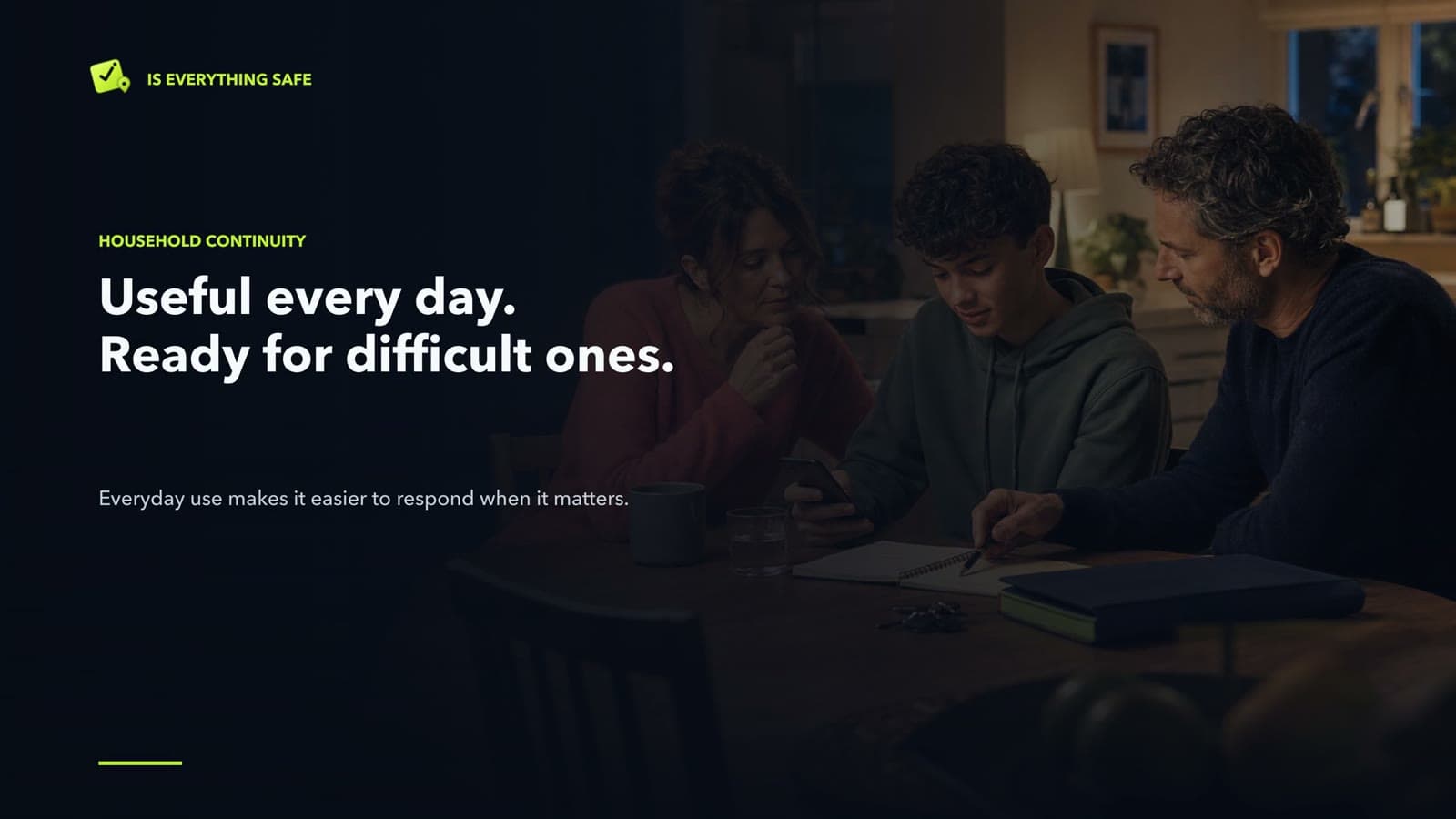
Modern family life rarely moves in one direction.
Many households are helping teenagers become more independent while taking on more responsibility for ageing parents. They may also be managing demanding work, household finances, appointments, travel, pets, property, and the quiet administration that keeps everyday life moving.
This is often described as the "squeezed middle" or the "sandwich generation". The pressure is not only about the number of tasks. It comes from being the person expected to know what matters, where it is, and what needs to happen next.
The challenge becomes most visible when ordinary life suddenly changes. At that point, a family does not simply need more information. The right people need trusted information they have permission to access, along with enough context to act confidently.
A Tuesday morning that changes shape
Imagine you are halfway through the school run when your phone buzzes: "Dad's had a fall."
Your mind immediately starts assembling the missing pieces. Which hospital? Who called the ambulance? What medication does he take? Where is Mum? Does your brother know? Can your sister collect the children? Which meeting can you move?
Then the rest of the morning continues. Your eldest messages about university accommodation. Your youngest needs collecting after football. Your partner is travelling for work. Your calendar was already full before the call arrived.
One event has changed the shape of the day, and suddenly everything depends on your ability to retrieve information spread across messages, drawers, inboxes, devices, and memory.
The invisible household load
Most households have some form of organisation. The weak point is that the system often depends on one person.
That person may know:
- the insurance details and renewal dates
- the NHS numbers and summary medical information
- the consultant, GP, pharmacy, or care-provider contacts
- where passports, wills, and property records are kept
- who can collect a child or check on a parent
- which neighbour has a spare key
- who to call about the boiler, the dog, or the house
- which allergies or medications matter in an emergency
Some of this may be written down, but rarely in a form that the right person can find quickly. Much of it lives in one person's head.
That is not just a mental-load problem. It is a household continuity risk.
When one person becomes the household operating system
The family organiser is not always the same person. It may be a parent, an adult daughter, an eldest son, a partner, or another trusted relative.
Without intending to, they become the household operating system. Everyone asks them. Everyday handovers flow through them. They know which details are current and which jobs are still outstanding.
The arrangement can work for years, until that person is busy, travelling, unwell, unreachable, or the one who needs help.
Shared preparedness is not about removing care or conversation. It is about making sure care does not depend on a single point of failure.
Independence changes what support looks like
As children grow older, family responsibilities do not disappear. They change.
PE kits become driving licences. School clubs become university accommodation. Play dates become independent travel, first jobs, late shifts, and holidays with friends.
Parents want teenagers and young adults to gain freedom. That freedom works best when practical preparation sits underneath it:
- emergency contacts are current
- important documents can be found if needed
- summary medical details are available to the right people
- everyone understands who to contact if plans change
The goal is not surveillance. It is enough shared context to help someone act when they choose to ask for support or when an emergency makes it necessary.
Supporting ageing parents with dignity
Older parents often want to remain independent, and adult children want to respect that independence. Preparing important information does not have to undermine either aim.
It can be as simple as agreeing what should be available, who should be able to see it, and where it will be kept if it is ever needed.
That preparation becomes useful as appointments increase, medications change, care providers become involved, or routine administration becomes harder to coordinate. A family does not necessarily need hundreds of new records. It needs reliable access to the small number of details that help the right person take the next step.
Formal medical records and clinical decisions still belong with the NHS and care providers. The household layer is practical: summary information, useful contacts, documents, reminders, and agreed responsibilities.
When information becomes urgent
Emergencies rarely arrive at convenient times. They happen while someone is at work, travelling, asleep, on holiday, or away from the person who normally holds the details.
After the initial shock, families often lose time to predictable questions:
- What medication do they take?
- Who needs to be called?
- Where are the relevant documents?
- Which hospital, insurer, school, or care provider is involved?
- Who else in the family needs an update?
- What still needs to happen at home?
Searching does not only take time. It increases the pressure on the person trying to coordinate everyone else.
Creating a shared household safety net
IsEverythingSafe is designed to help households organise the practical information around everyday life and make it available through controlled shared access.
That can include:
- summary medical details, such as medications, allergies, conditions, and useful contacts
- family, professional, school, university, neighbour, and care-provider contacts
- insurance, identity, property, legal, and household documents
- reminders for renewals, appointments, reviews, and other important dates
- plans, steps, and responsibilities around a life event or disruption
- shared household access, with permissions for sensitive records
Sensitive documents and summary medical details can be protected with client-side encryption. Customer data is hosted in the UK, and households choose who to invite and which records those people can view or manage.
The aim is not to open everything to everyone. It is to give the right people the right level of access before a handover becomes urgent.
What this can look like in everyday life
An older parent is admitted to hospital
An adult daughter can find the summary medication information, useful contacts, care-provider details, and the agreed family contact list. She spends less time searching and more time supporting her father.
A teenager travels abroad
The family has already checked emergency contacts and agreed where important travel and medical details are kept. The young person gains independence without relying on a parent to retrieve every detail for them.
A young adult moves to university
Accommodation information, insurance details, emergency contacts, and relevant records are organised in one household context. The move becomes a shared transition rather than a trail of disconnected messages.
A household disruption changes the day
A burst pipe, power cut, lost phone, or unexpected journey creates work for more than one person. Shared contacts, documents, reminders, and responsibilities mean someone else can step in without starting from scratch.
Reducing the load by sharing it
The practical value of a household system is easy to see: fewer searches, fewer repeated calls, clearer handovers, and less duplication.
The human value is just as important.
The person carrying the household knowledge no longer has to remember everything alone. Responsibility can be distributed. Other family members can take a useful role without needing a full briefing each time.
The shift is small but meaningful. Instead of "Only I know where that is", a household can say, "The people who may need it know where to find it."
That is what household continuity looks like in everyday life: not expecting that nothing will go wrong, but making the next step easier when plans change.
Final thought
The squeezed middle is not defined by one family structure or one age group. It describes the growing experience of supporting people in more than one direction while trying to keep work and home moving.
Technology cannot replace family connection, professional care, emergency services, or official guidance. It can make the practical layer underneath those relationships more dependable.
When important information, contacts, reminders, and responsibilities are organised and shared appropriately, one person no longer has to carry the entire household in their head. The family is better able to stay organised, connected, and ready to act together.
Build your household setup before you need it
Keep important records, contacts, reminders, trusted alerts, and ownership information in one place so your household can act earlier and recover with less chaos.


